“Your word is a lamp for my feet, a light on my path.” — Psalm 119:105, NIV
You know when you wake up in the middle of the night and convince yourself you know your way around well enough to make it without turning on a light? Until you violently bump your pinky toe on a corner of a piece of furniture you swear wasn’t there earlier…
Now, imagine trying to navigate an unfamiliar path outside in the wilderness in the middle of the night. I'd guess you'd probably want a flashlight. And you wouldn’t just want to keep one in your bag—you would want to hold it in your hand, turn it on, and point it down the path ahead.
The Hebrew word translated as “lamp” is ner (נֵר), meaning lamp or light. In ancient Israel, people commonly used small clay lamps fueled by oil. Unlike modern LED flashlights and electric lights that can literally blind you (seriously, whose idea was it to put those blinders on cars), these lamps lit only a small area. They didn’t light up an entire mountainside or show miles of road ahead. They simply gave off just enough light to help someone navigate the darkness immediately around them.
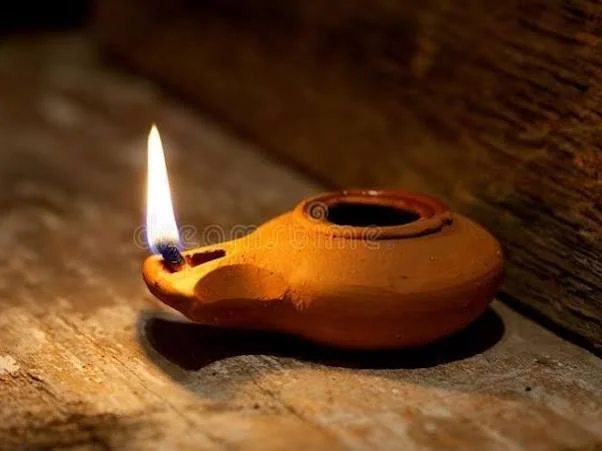
David and his men spent years fleeing from Saul, hiding in caves and traveling through the wilderness (1 Samuel 22-24). At the time, these small oil lamps were essential for navigating the dark, rocky terrain. While a small lamp couldn’t illuminate the entire cave or reveal every obstacle, it could provide just enough light to take the next few steps.
David uses the imagery in his song of deliverance:
“You, LORD, are my lamp; the LORD turns my darkness into light. With your help I can advance against a troop; with my God I can scale a wall. As for God, his way is perfect: The LORD's word is flawless; he shields all who take refuge in him” (2 Samuel 22:29-31, NIV).
David knew what it meant to navigate uncertainty and danger without knowing what lay ahead. He also knew the faithfulness of his God, who sustained him. His confidence wasn’t in knowing every step. His confidence rested in the Lord whose ways are perfect and whose Word is trustworthy.
But even with a lamp available, the traveler still had to carry it, keep it burning, and follow the light it provided. The same is true of our “lamp”—God’s Word. We can own a dozen Bibles (and the apps!) and listen to all the sermons in the world, but none of that replaces personally knowing God’s Word and living by it.
And as believers, we have the incredible privilege of knowing the Light of the World himself! Jesus tells us:
“I am the light of the world. Whoever follows me will never walk in darkness, but will have the light of life” (John 8:12, NIV).
God has graciously given us His Word to instruct us, illuminate our paths, reveal his character, teach us his ways, and help us distinguish truth from the darkness around us. We also have the Son of God to follow. But how often do we stumble through dark situations while the very light we need sits unopened or tucked away in our backpacks? Jesus doesn’t just promise to show us the way—he calls us to follow him; we have to walk in the light he provides.
“For this command is a lamp, this teaching is a light, and correction and instruction are the way to life” (Proverbs 6:23, NIV).
The Word of God doesn’t just make us feel better when things are difficult (it certainly can). It corrects us, teaches us, exposes sin, and instructs us in righteousness.
We need the light when we’re tempted to compromise our convictions, when we’re struggling with anger or bitterness, when we’re deciding how to handle a situation, or when we’re trying to distinguish godly wisdom from the opinions of the world. We need it for ordinary, everyday decisions and moments too.
Psalm 119 is filled with this desire to know and obey God’s Word. David continually returns to God’s commands, statutes, precepts, and promises because he recognizes their value in directing his life. In fact, many scholars believe he wrote this acrostic poem as an instruction for his son, Solomon, on how to live according to God’s Word.
Earlier in the poem, he asks:
“How can a young person stay on the path of purity? By living according to your word” (Psalm 119:9, NIV).
And later:
“The unfolding of your words gives light; it gives understanding to the simple” (Psalm 119:130, NIV).
We cannot expect to recognize what is contrary to God’s character if we aren’t actively learning what his character is like. We cannot expect to discern truth from deception if we aren’t familiar with the truth in the first place. And we certainly can’t expect to navigate every difficult circumstance on our own understanding when God has given us his Word for instruction.
We may not always be able to see far ahead, but we have what we need to walk faithfully in the light God has provided. We are responsible for picking up the lamp and taking it with us as we follow Jesus.
Here’s a question worth considering today: Are you actually allowing God’s Word to direct your steps, or are you trying to find your way through the darkness while leaving the lamp untouched?
The lamp has been provided—we need to know it, carry it, and walk step by step in the light it gives.
bytaylormcgee